Source raster mask
A source raster mask flags pixels in the source image as invalid. Any output sample whose interpolation footprint overlaps an invalid source pixel is itself flagged invalid and set to nodata_out. Unlike the grid mask, which operates on output samples, the source raster mask operates on input pixels.
What you’ll learn
How to build and save a source raster mask
How to pass it through
array_src_mask_ds,array_src_mask_validity_pairandarray_src_mask_bandHow source-mask invalidation propagates to the output mask
Setting things up
We reuse the source raster, grid file and grid mask from the previous notebook. The source raster mask itself is created below if absent.
Building the source raster mask
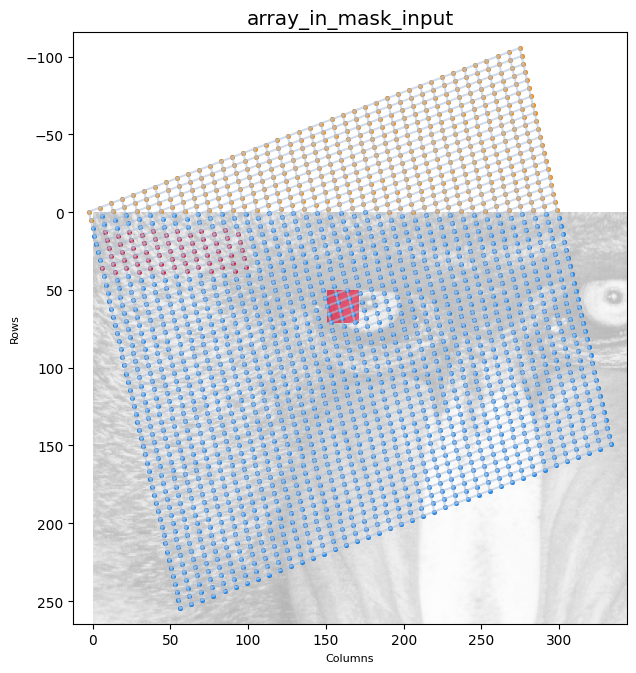
We mark a small square near the mandrill’s left eye as invalid.
array_src_mask_validity_valid, array_src_mask_validity_invalid = 1, 0

# Create the mask raster, initially all valid.
array_in_mask = np.full(mandrill[0].shape, array_src_mask_validity_valid, dtype=np.uint8)
array_in_mask[slice(50, 71), slice(150, 171)] = array_src_mask_validity_invalid

write_array(array_in_mask, dtype=np.uint8, fileout=raster_mask_in_path_u8)
The invalid region is shown below as a red square overlaid on the source image. The grid mask coloured nodes are also visible.
Running the chain with the source mask
Three arguments are needed:
array_src_mask_ds– opened mask dataset,array_src_mask_validity_pair–(valid_value, invalid_value)tuple,array_src_mask_band– band index to read.
with rasterio.open(GRID_IN_F64, "r") as grid_in_ds, \
        rasterio.open(RASTER_IN, "r") as array_src_ds, \
        rasterio.open(grid_mask_in_path, "r") as grid_mask_in_ds, \
        rasterio.open(raster_mask_in_path_u8, "r") as raster_mask_in_ds, \
        rasterio.open(output_raster_path, "w", **raster_out_open_args) as array_out_ds, \
        rasterio.open(output_mask_path, "w", **mask_out_open_args) as mask_out_ds:

    basic_grid_resampling_chain(
        grid_ds                        = grid_in_ds,
        grid_row_coords_band           = 1,
        grid_col_coords_band           = 2,
        grid_resolution                = grid_resolution,
        array_src_ds                   = array_src_ds,
        array_src_bands                = 1,
        array_out_ds                   = array_out_ds,
        interp                         = "cubic",
        nodata_out                     = 0,
        mask_out_ds                    = mask_out_ds,
        grid_mask_in_ds                = grid_mask_in_ds,
        grid_mask_in_unmasked_value    = grid_mask_in_valid_value,
        grid_mask_in_band              = 1,
        array_src_mask_ds              = raster_mask_in_ds,
        array_src_mask_band            = 1,
        array_src_mask_validity_pair   = (array_src_mask_validity_valid,
                                          array_src_mask_validity_invalid),
    )
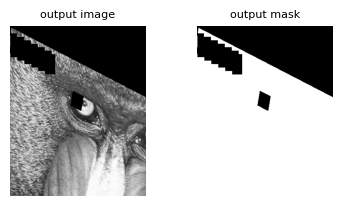
Both masks contribute to the output mask: any output sample is invalid if its grid node is masked or if its interpolation kernel touches an invalid source pixel.