Image Geometry
Continuous Image Domain
We consider that the discrete image originates from an underlying continuous signal
defined over a rectangular domain \(\Omega\).
The coordinates \((x, y) \in \Omega\) are continuous spatial coordinates, with \(x\) increasing to the right and \(y\) increasing downward.
The function \(F\) represents the ideal, infinitely-resolved image intensity at any real-valued location in \(\Omega\).
The digital image is a sampling of this continuous signal.
Discrete Image
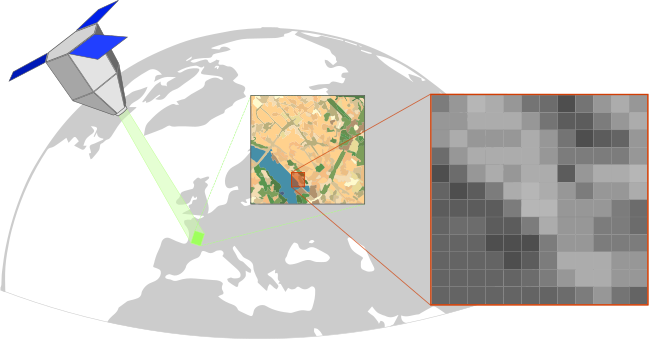
A discrete image \(I\) of width \(W\) and height \(H\) is the finite regularly sampled function from the underlying continuous signal \(F\).
with elements \(I[i,j] \in \mathbb{R}\) called pixels.
Pixel model
A discrete coordinate \((i, j)\) refers to the pixel at row index \(i\) and column index \(j\), with \((0, 0)\) referring the upper-left pixel.
Each pixel corresponds to a rectangular region \(R_{i,j}\) in the continuous domain. GridR uses the Pixel is Point sampling convention :
Consequences :
pixel centers lie on integer coordinates
pixel edges lie on half-integer coordinates
the center-to-center spacing is 1 in both directions.
Sampling Grid
To avoid ambiguity between array indices and geometric coordinates we define the sampling grid (the sampling lattice) explicitly :
In the Pixel is Point sampling convention used in GridR, each integer coordinate \((j, i) \in \mathbb{Z}^{2}\) corresponds to the center of pixel \((i, j)\) in the discrete image \(I\). We therefore use the mapping :
All geometric operations and transformation are expressed in this coordinate system.
Image Footprint
Given image width \(W\) and height \(H\), the continuous domain covered by the discrete image \(I\) — the footprint — is