The grid_rasterize module
This notebook introduces grid_rasterize, GridR’s low-level rasterisation utility. It converts a Shapely geometry into a binary raster aligned with a target coordinate frame, and powers the higher-level build_mask API covered in the next notebooks.
What you’ll learn
The two ways to define a target frame:
grid_coordsvs.(shape, origin, resolution)The
inner_value/outer_value/default_valuesemanticsHow to limit the computation to a sub-window
The available rasterisation algorithms in GridR
Setting things up
GridR currently integrates two backends for rasterisation: shapely and rasterio. The shapely path is still available in the codebase but is significantly outperformed by rasterio, so we use the rasterio algorithm exclusively here. Note that no Rust rasterisation backend exists yet.
Calling grid_rasterize
We rasterise a polygon defined in the half-real convention against the shared (6, 8) raster. Two target-frame options exist:
pass a pre-built coordinate array through
grid_coords, orpass the triplet
(shape, origin, resolution).
Here we use the second option. The origin argument expects the geometry’s origin (the rasteriser’s internal convention matches GridR’s).
from gridr.core.grid import grid_rasterize

# Rasterio-based rasterisation algorithm.
alg = grid_rasterize.GridRasterizeAlg.RASTERIO_RASTERIZE
kwargs_alg = {}

# Burn-in values.
inner_value, outer_value, default_value = 1, 2, 0

geometry_origin = (0.5, 0.5)
geometry = shapely.geometry.Polygon([
    (3.5, 2.5),
    (6.5, 2.5),
    (6.5, 4.5),
    (3.5, 4.5),
])

raster = grid_rasterize.grid_rasterize(
    grid_coords   = None,
    shape         = shape,
    origin        = geometry_origin,
    resolution    = resolution,
    win           = None,
    inner_value   = inner_value,
    outer_value   = outer_value,
    default_value = default_value,
    geometry      = geometry,
    alg           = alg,
    dtype         = np.uint8,
    **kwargs_alg,
)
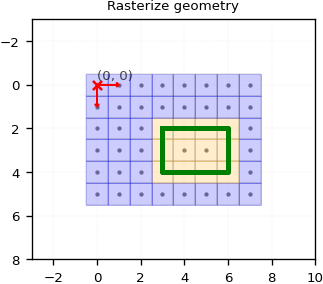
Pixels whose centroids fall inside or on the contour of the geometry are burned with inner_value (orange). All other pixels receive outer_value (blue). default_value is only used when no geometry at all is provided (passing geometry=[]).
Empty geometry
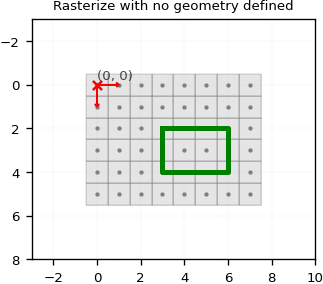
Passing an empty list [] triggers the default_value path – every pixel is burned with default_value. Passing None instead would raise an exception.
raster = grid_rasterize.grid_rasterize(
    grid_coords   = None,
    shape         = shape,
    origin        = geometry_origin,
    resolution    = resolution,
    win           = None,
    inner_value   = inner_value,
    outer_value   = outer_value,
    default_value = default_value,
    geometry      = [],
    alg           = alg,
    dtype         = np.uint8,
    **kwargs_alg,
)
Limiting computation with win
win restricts the rasterisation to a sub-region of the full target grid. It follows GridR’s window convention – a list of (start, end) inclusive index pairs, row first then column.
The output array shape and values reflect only the requested window.
win = np.array([(1, 3), (5, 7)])
raster = grid_rasterize.grid_rasterize(
    grid_coords   = None,
    shape         = shape,
    origin        = geometry_origin,
    resolution    = resolution,
    win           = win,
    inner_value   = inner_value,
    outer_value   = outer_value,
    default_value = default_value,
    geometry      = geometry,
    alg           = alg,
    dtype         = np.uint8,
    **kwargs_alg,
)
display(raster)
array([[2, 2, 2],
       [1, 1, 2],
       [1, 1, 2]], dtype=uint8)
The next three notebooks build on top of grid_rasterize to demonstrate build_mask, the higher-level API for combining geometry-based and raster-based masks into a single binary mask.